home: research: centers and laboratories: chmr: movement dynamics laboratory

Movement Dynamics Laboratory


Dr. Melissa Gross

1206 CCRB
401 Washtenaw Ave.
Ann Arbor, MI 48109-2214
Phone: (734) 763-0013
Dr. Gross' Research Website (leaving Kinesiology site)


Research Overview

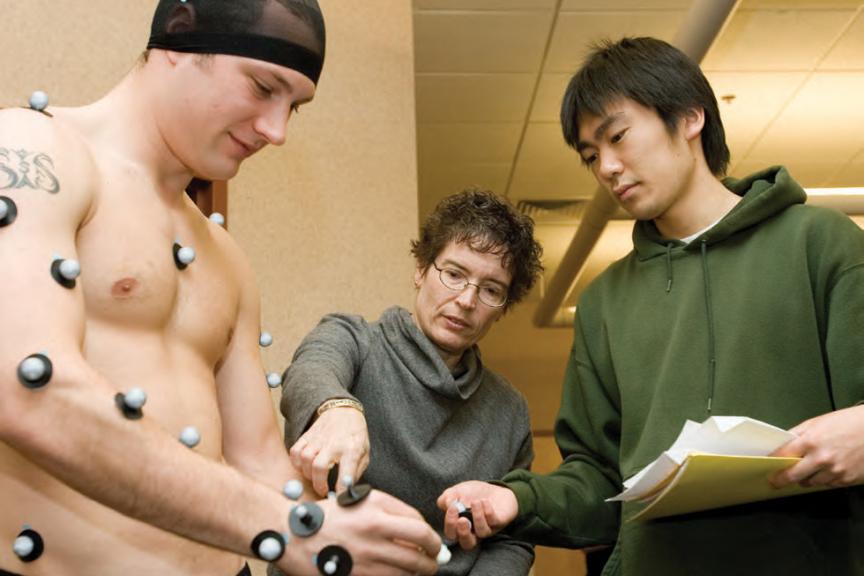
Research in our lab aims to understand how human movement patterns are changed in characteristic ways when different emotions are expressed. We use an interdisciplinary approach, combining biomechanical methods for recording and assessing body movements with psychological methods for eliciting and validating emotions. Expressive movement serves an important role in human interactions, yet we do not know how emotions are linked to recognizable movement qualities. By studying the biomechanics of expressive movement, our research extends the understanding of how emotion is manifest in body systems.


Current Projects

Kinematics of emotional expression

People can easily detect the emotion that another person is feeling by observing their body movements. What, exactly, makes a sad movement look sad? In this series of studies, we use motion capture and kinematic analysis to characterize how emotions affect movements in specific, recognizable ways. By combining biomechanical and psychological methods, these studies provide the basis for a new understanding of the relationship between emotional experience and body movements. (more)

Concurrent expression in the face and body

Emotions are expressed through multiple channels - face, voice, body, subjective feelings and physiological responses - and typically are expressed in more than one channel at a time. Although the face and body both show emotion, we know surprisingly little about the simultaneous display of emotion in the face and body. The purpose of this project is to explore the concurrence of facial and bodily expressions of emotion during movement. In these studies, autobiographical memories are used to elicit emotions and self-reports are used as a manipulation check. Emotional expressions in body movements are validated using observer recognition studies. Facial expressions are quantified using the Facial Action Coding System (FACS). (more)

Recognition of emotion in body movements

What makes a joyful movement look joyful? To answer this question, joyful movements must be identified, and then the specific characteristics of joyful movements can be determined. In this series of studies, we use social consensus to determine whether or not a movement expresses a specific emotion. We assume that emotions alter the performance of a movement in specific ways that can be recognized by observers. In these recognition studies, observers are shown video clips of people moving while they are experiencing different emotions and the observers are asked to determine which emotion they think the person is feeling. (more)


Body representation and perception of affect

How life-like does an animated character need to be so that emotional expression can be recognized in the character’s movement? To explore this question, we used the same motion data to animate different representations of the body. The motion data were collected from an actor knocking on a vertical board while experiencing different emotions. The body representations were solid models, stick figures, videos and point light displays (from left to right below ). We compared emotion recognition among the representations and found that anger trials were recognized with all display types but recognition of other emotions depended on the type of display. (more)

Functional Ability in Women During Midlife

The purpose of this NIH-funded study was to assess changes in the ability to perform functional movement tasks in women who are age-eligible to experience the menopausal transition. Body movement data were collected on approximately one thousand women per year as they climbed stairs, rose from a chair, lifted an object, reached as far as possible, and walked. The biomechanical data were integrated with other data such as hormone status, osteoarthritis, and self-report of functional ability to describe the trajectory of functional ability across mid-age in women. (more)


Back to Top


News

  • Rackham International Students Fellowship to Lan Wei
    rackham

    We are extremely pleased to announce that Lan Wei, first year Kinesiology doctoral student, has been awarded a Rackham International Students Fellowship for 2007/08. Lan studies biomechanics under Dr. Melissa Gross. She holds BS and MS degrees in Biomedical Engineering from Shanghai Jiao Tong University in China. She is also an accomplished ballet dancer, having achieved the highest level of certification from the Royal Academy of Dance. She is currently investigating recognition of emotion in body movements.


Back to Top


Members

Faculty:
   Melissa Gross, Ph.D. (mgross@umich.edu), Director and Associate Dean for Research
Graduate Student(s):
   Melanie Cluss (mbcluss@umich.edu)
   Beth Crane (bcrane@umich.edu)
   Lan Wei (lanwei@umich.edu)
Undergraduate Student(s):
   Erica Lewis (erlewis@umich.edu)
   Zara Schulman (sczara@umich.edu)
   Kota Takahashi (ktaka@umich.edu)
   Zach Webster (zweb@umich.edu)
   Tegan Wetherbee (tegbee@umich.edu)
   Kelly Woznicki (kwoz@umich.edu)
Collaborators:
   Barb Fredrickson, Ph.D. (blf@umich.edu), U-M College of LS&A [Psychology]
   Geoff Gerstner, Ph.D. (geger@umich.edu), U-M School of Dentistry [Biologic and Materials Sciences]


Back to Top
Contact Us Division of Kinesiology


The University of Michigan